
E-bikes in Canberra
Electric. Not complicated.
An e-bike can flatten hills, extend your range and make everyday riding more practical. Start with a legal, roadworthy bicycle that is safe to use on Canberra's roads and paths.
Legal in the ACT
Two categories. One clear starting point.
An e-bike must meet every requirement of one of these categories to be treated as a bicycle in the ACT.
Electrically power-assisted cycle
Also called an EPAC, pedalec or 250-watt pedal-assist e-bike.
- Must meet the EN15194 standard
- Power progressively reduces above 6 km/h
- Motor assistance cuts off at 25 km/h
- Above 6 km/h, assistance is provided only while pedalling
- May have controlled start assistance up to 6 km/h
Power-assisted pedal cycle
Also called a PAPC or 200-watt power-assisted bicycle.
- Pedalling must provide real propulsion
- The motor must only supplement human power
- Must have working pedals
- Must have a height-adjustable seat
- Must not have an internal combustion engine
Before you buy
Four checks. One confident purchase.
A reputable Canberra bicycle shop can explain the specifications, provide after-sales support and help you choose a bicycle that fits your riding.
Check the category
Ask whether the bicycle is an EN15194-compliant EPAC or a 200-watt power-assisted pedal cycle. Get the specifications in writing.
Find the label
For an EPAC, look on the frame for an EN15194 compliance label showing the power and assistance cut-off.
Check the support
Ask about the warranty, servicing, replacement battery availability and whether the charger is supplied for that exact battery.
Test the fit
Consider weight, braking, carrying capacity, step-through height, storage and whether you can control the bicycle comfortably.
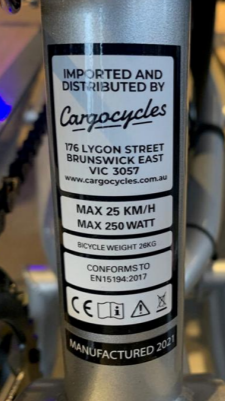
The compliance label
Small sticker. Important information.
A compliant EPAC should carry an EN15194 label on its frame. It should identify the standard, maximum continuous rated power and assistance cut-off speed.
No meaningful pedals
The pedals are absent, decorative or do not propel the bicycle.
High-powered assistance
The motor continues to assist an EPAC above 25 km/h.
Fixed seat
A 200-watt PAPC does not have a height-adjustable bicycle seat.
Modified controls
The motor, controller, throttle or speed limiter has been altered.
Riding in Canberra
Same places. Same road rules.
A legal e-bike has the same access as an unpowered bicycle. Ride to the conditions and follow the ACT bicycle rules.
Shared paths and footpaths
Keep left unless it is impractical, give way to people walking, choose a safe speed and use your bell or voice when appropriate.
Roads and bicycle lanes
Follow the same rules as other bicycle riders. If a bicycle lane is provided, use it unless it is impractical to do so.
Your bicycle
Wear an approved helmet. The bicycle must have an effective brake and warning device. Use the required lights and rear reflector at night or in hazardous weather.
Lithium-ion battery safety
Charge carefully. Ride confidently.
A damaged, modified or incorrectly charged lithium-ion battery can overheat, catch fire or release toxic gas.
- Use the charger supplied for that exact battery
- Allow the battery to cool after riding before charging
- Charge on concrete, ceramic, steel or another non-flammable surface
- Monitor charging and disconnect the battery when fully charged
- Store it in a cool, dry place away from direct sunlight
- Buy replacements from the original or another reputable supplier
Pedal Power's position
E-bikes should expand who can ride.
Pedal Power supports legal and roadworthy electric bicycles being used anywhere an unpowered bicycle can lawfully be ridden.
We also support clear, nationally consistent standards that help people recognise safe products and prevent non-compliant high-powered devices from being sold as bicycles.
Good to know
E-bike questions, answered.
Rules depend on whether the bicycle meets one of the two ACT definitions. Check official guidance if you are uncertain.
01Do I need a licence or registration for a legal e-bike?
No. An electric bicycle that meets one of the two ACT definitions is treated as a bicycle. A non-compliant device may instead be classified as a motor vehicle.
02Can a legal e-bike be ridden on a shared path?
Yes. A legal e-bike can be used anywhere an ordinary bicycle can be ridden in the ACT. On shared paths and footpaths, keep left unless impractical and give way to pedestrians.
03Can I modify the motor or speed limiter?
A modification can make a previously compliant bicycle illegal. Do not alter the motor, controller, throttle or speed limiter in a way that takes the bicycle outside its legal category.
04Does membership insurance cover an illegal e-bike?
No. Pedal Power's insurance information lists riding an illegal or non-compliant bicycle as outside the scope of cover. Read the current policy documents for all terms, conditions, limits and exclusions.
Read the insurance page05Are e-scooters covered by the same rules?
No. E-scooters are personal mobility devices and have different access and speed rules. Check current Transport Canberra guidance before riding one.
Useful resources
Check before you buy or ride.
Use the official sources for current rules and product safety advice.
ACT e-bike requirements
Transport Canberra's legal categories and permitted riding locations.
02Pedal Power position
Our complete position on electric bicycles, e-scooters and safe use.
03Battery safety
ACCC guidance for buying, charging, storing and disposing of batteries.
04Membership insurance
Current policy information, exclusions and legal documents.